The frame is formed of four twisted hollow tubes, closed with lion-headed clasps, which divide the crescent into three registers. In the lowest, horses are attacked by lions and griffins. The middle register is a floral plaque with birds. The upper shows everyday life: two kneeling men hold a fleece between them, horses suckle foals, a cow nurses a calf, one Scythian milks a sheep while another holds an amphora, and a goat stands with its young among birds.1
Why it matters
The upper register is an unusually direct picture of herding life — handling a fleece, milking, the care of young animals — set against the violence of the animal combat below, all worked at miniature scale in gold. It was found in a fourth-century BC kurgan and is kept in the Treasury of the National Museum of the History of Ukraine in Kyiv.1,2
Found outside the tomb
Borys Mozolevskyi, head of the Institute of Archaeology’s expedition, found the pectoral on 21 June 1971. It lay at the bottom of the dromos, the entrance passage to the underground burial chamber of Tovsta Mohyla, a fourth-century BC Scythian kurgan. A sword, quivers, a whip and the skeleton of a servant lay nearby. Why it was there remains unexplained. It has been interpreted as the remains of a sacrificial rite, as an offering made a year after the funeral, as a diplomatic gift, and as loot dropped or ignored by grave robbers. Babenko adds a further puzzle: the tomb itself seems modest for the owner of a royal insignia. As he puts it, these readings share only their speculative character.2
A pectoral or a torc?
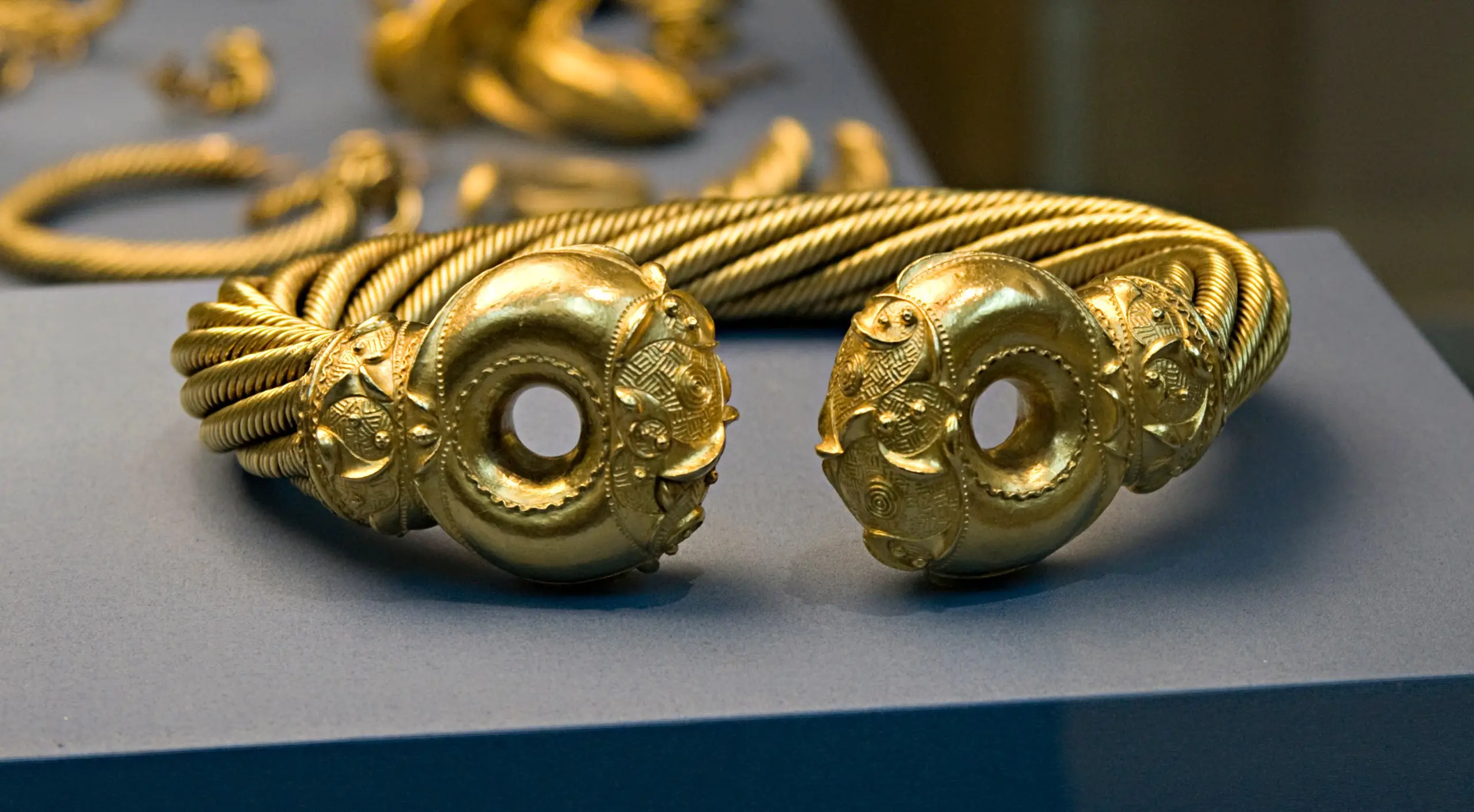
It has been called a pectoral since it was found, but pectorals were rare among the Scythians and the origins of the type are unclear. Its false twisted braids, figures of animals and people, and lion-headed finials closely resemble Scythian torcs of the same period, and many researchers, Babenko among them, see it as an especially elaborate torc, the Scythians’ pre-eminent symbol of status. The museum stresses that it is unique. Its design draws on many traditions: local Bosporan metalwork, Achaemenid, Thracian and Greek models, the plant ornament of Macedonian diadems from Vergina and Stavroupoli, and even Greek coins, which had shown a cow suckling its calf since sixth-century Corcyra. Several scholars have compared it with the shield of Achilles in the Iliad, another cosmic picture built from opposing scenes in high relief.2,1
Over 160 parts
The pectoral is assembled from more than 160 separate parts. Its movable hinges may have been borrowed from Greek helmets with hinged cheek-pieces, known in the region from the first half of the fourth century BC. The four twisted tubes of the frame are the least understood part. Drawing on a torc from Kul-Oba, built on twisted bronze tubes plated with gold, Babenko reconstructs a gold sheet pressed around a twisted core of copper tubes and then unscrewed from it. He has tested the method experimentally. A torc from the Solokha kurgan shows a similar technique, raising the possibility that both came from the same workshop.2
A picture of the Scythian world
The museum describes the composition as a Scythian cosmogony, making the pectoral an object of cult as well as of adornment. The most widely accepted reading, by Dmitry Raevsky, treats it as a model of the world built around a world tree and a universe of three tiers. Babenko proposes that the central scene of two men with a fleece showed a ritual by which a king gained divine favour, at his election at the spring equinox. Today the pectoral is a symbol of Ukraine’s archaeology and ancient history, reproduced on coins, stamps and monuments in Kyiv, Donetsk and Mykolaiv.2,1