The top of the stele carries a relief: the sun god Shamash, seated on a throne and holding out a rod and ring, faces King Hammurabi, who wears a robe leaving the right shoulder bare and a high-brimmed cap. Below runs a cuneiform text in Old Babylonian — a body of laws and judicial decisions.
The Louvre records the stele as broken. Although made in Mesopotamia, it was found at Susa and came to the museum through the division of finds after excavation. It stands in the Richelieu wing, Room 227.1
Why it matters
The stele joins image and text into a single statement of royal justice. As the Louvre describes it, the meeting between king and god at the top legitimises Hammurabi’s sovereignty and the judicial decisions engraved below it — law presented as something granted under divine authority.1
From Sippar to Susa
The stele is a block of black basalt more than 2.25 metres tall. Hammurabi of Babylon (1792–1750 BC) probably set the stele up at Sippar, the city of Shamash, and other monuments in the same tradition stood in the towns of his kingdom. It was carved in the last years of his life, a political testament meant for the princes who would follow him. Some six centuries later the Elamite king Shutruk-Nahhunte, who reigned around 1185–1160 BC, carried it off to Susa as a spoil of war, and it was displayed on the Susa acropolis among other prestigious Mesopotamian monuments. French excavators found it there in 1901–02, and it has been on show at the Louvre since 1904.4,3
Not a code in the modern sense
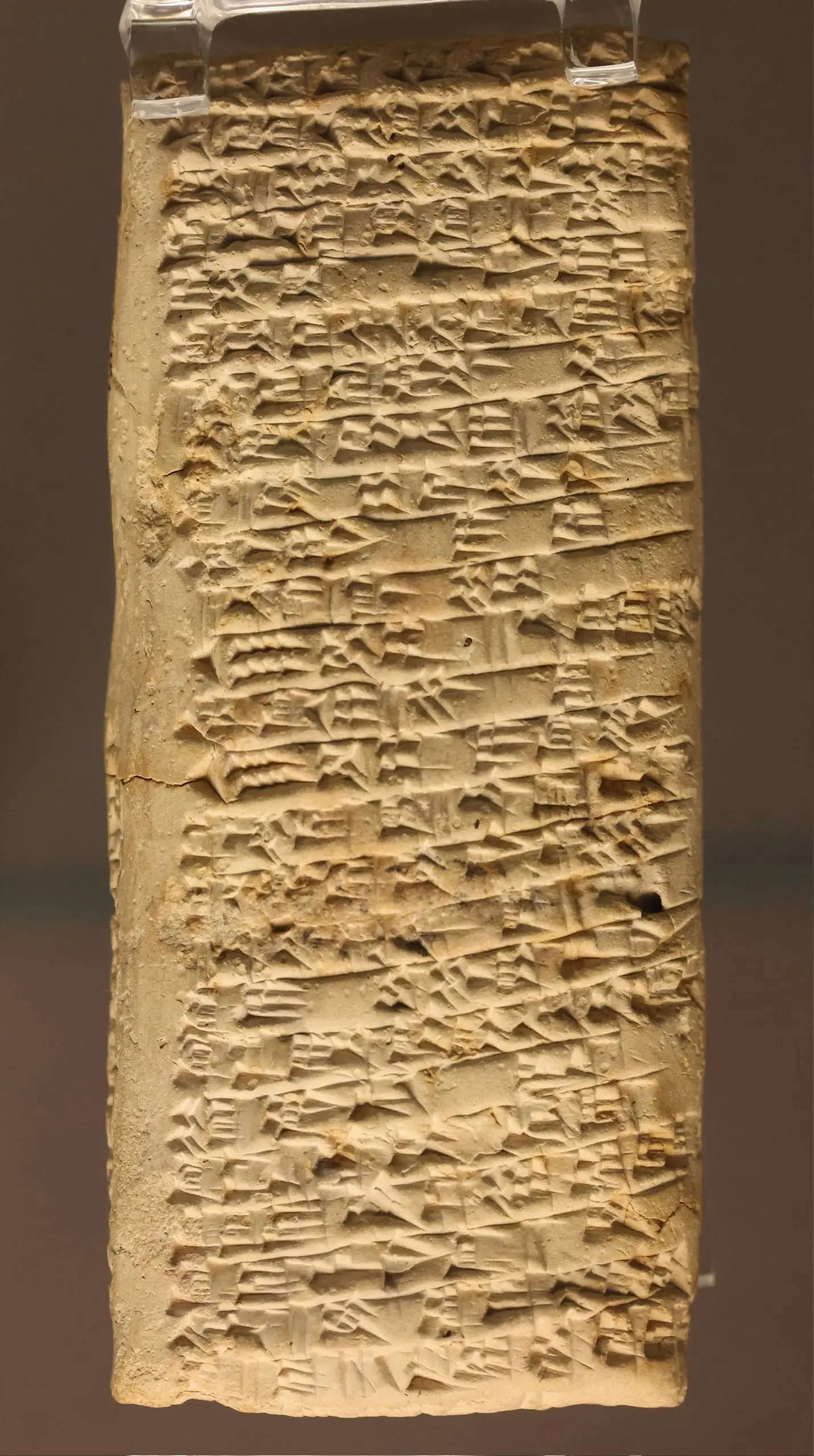
The text is written in cuneiform in the Akkadian language. A historical prologue presents Hammurabi as “protector of the weak and oppressed” and lists his conquests and works; a lyrical epilogue sums up his legal work and provides for its future. Between them stand 282 surviving judgements, grouped in chapters on matters such as family, property, trade and labour, slavery, agriculture and administration, with fixed prices and wages. The longest chapter concerns the family: engagement, marriage and divorce, adultery, children, adoption, inheritance and the duties of wet-nurses. The Louvre stresses that this is a collection of case law rather than a code in today’s sense — particular judgements with the names removed, which is why similar cases can sometimes have different outcomes.3,4
If, then
Every judgement follows the same pattern, also used in Mesopotamian treatises on divination and medicine: a clause beginning “if” sets out the case in detail, and a second clause gives the ruling or penalty. Law 196 reads: “If a man put out the eye of another man, his eye shall be put out” — the basis of what is now called the law of retaliation, “an eye for an eye, a tooth for a tooth”. The museum reads it not as a call for vengeance but as a rule that punishment must be proportionate to the harm done. The legal part uses everyday, simplified language, as the king wanted it to be understood by all.3,4
Before and after
The stele was not the first such collection. Two Sumerian law texts, issued by Ur-Namma of Ur around 2100 BC and Lipit-Ishtar of Isin around 1930 BC, came before it and were among its sources; it in turn predates the laws of the Bible. Besides the judgements it lists the towns and territories annexed to Babylon, making it a summary of one of the most prestigious reigns of ancient Mesopotamia. Scribal schools went on copying it as a literary model for more than a thousand years.4