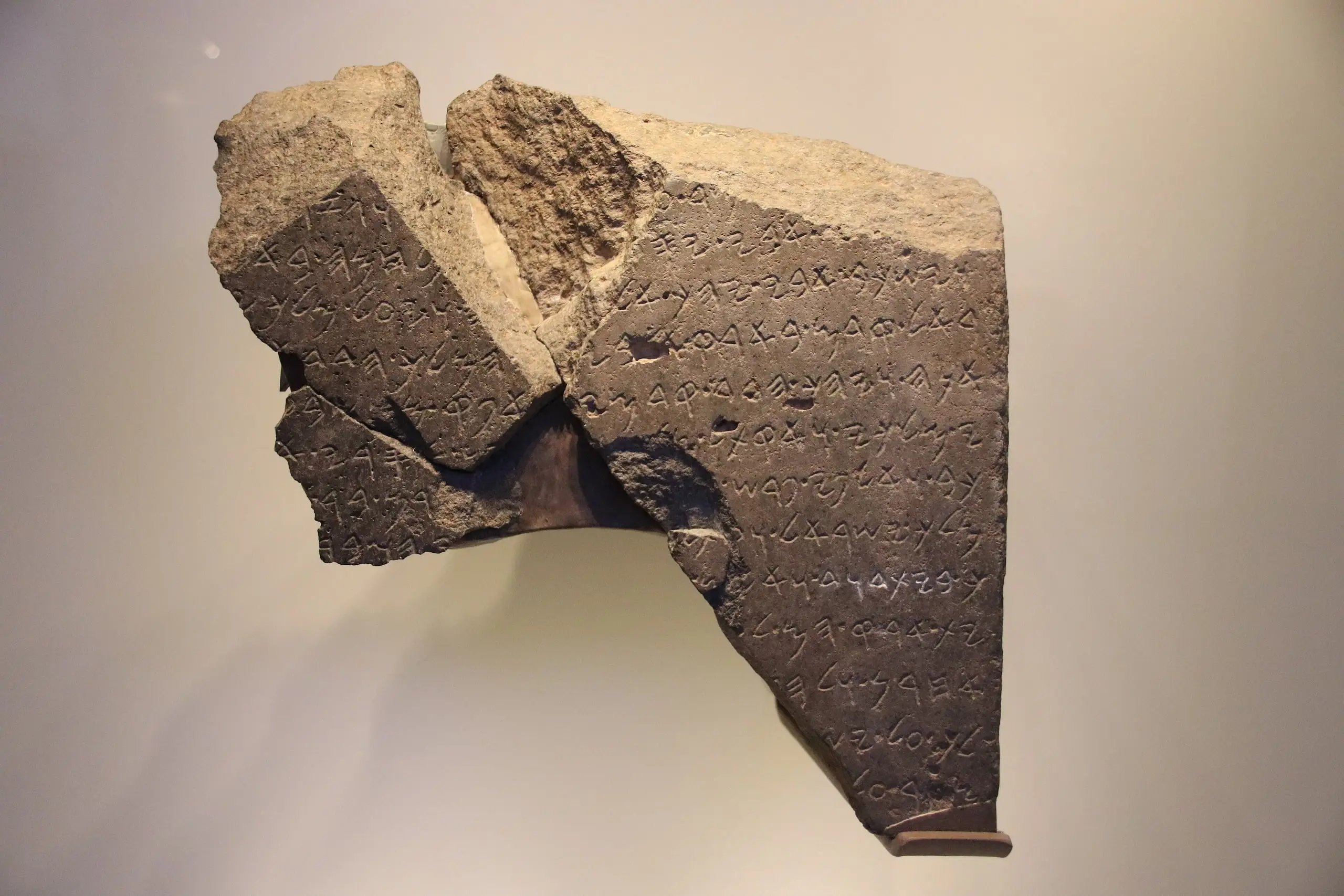
A round-topped basalt stele carries 34 lines in a Phoenician-type script, in a dialect very close to Hebrew. According to the Louvre, it was engraved for the dedication of a sanctuary to the god Kemosh and tells how Mesha recovered many Moabite territories from Israel.
The Louvre describes it as incomplete, fragmented, rejoined and completed. It was purchased in 1873 and stands in the Sully wing, Room 303.1
Why it matters
It is a royal inscription from Israel’s neighbour and rival, written in a language closely related to Hebrew, and it narrates conflict with the kingdom of Israel from the Moabite side — an outside perspective on events that also appear in the Hebrew Bible.1
What the stone says
The text opens in the king’s own voice: “I am Mesha, son of Kemosh-…, king of Moab, the Dibonite. My father reigned over Moab thirty years, and I reigned after my father.” Mesha explains that he built a high place for Kemosh because the god had saved him from all his enemies. Omri, king of Israel, “had oppressed Moab for many days, for Kemosh was angry with his land”, and Omri’s son meant to do the same; Israel had held the land of Medeba for forty years. The inscription then reports Mesha’s campaigns: the capture of Ataroth, the night march on Nebo at Kemosh’s command, from which he took the vessels of Yahweh and dragged them before Kemosh, and the taking of Jahaz, which he annexed to Dibon.2,3
Builder king
The later lines turn to construction. Mesha records that he built Baal-meon, where he made a ditch, and Kiriathaim; a royal palace, with prisons for criminals within the wall; and a ditch for Karchah, dug, in the Yarmouk translation, “with the chosen men of Israel”. The bottom of the stele is lost. By analogy with Assyrian royal inscriptions of the same period, scholars at Yarmouk University’s Faculty of Archaeology expect that it ended with blessings and curses. The words are separated by dots and the sentences by short vertical strokes.2
Broken and reassembled
The stele was found intact at Dhiban, about fifty kilometres south of Amman, in 1868. European agents competed to obtain it. Charles Clermont-Ganneau, then serving as a dragoman in Jerusalem, had a hand copy made and then a paper squeeze, which reached him torn in November 1869. Around that time the Bani Hamida, who held the stone, broke it rather than hand it over. Clermont-Ganneau bought the two largest fragments, while the British engineer Charles Warren acquired eighteen smaller ones, later given to Clermont-Ganneau by the Palestine Exploration Fund. The Louvre bought the reassembled stele from him in 1873. It still keeps his squeeze, recorded as made at Dhiban in 1869, under its own inventory number.4,2,1
Marks of fire
The stone was cut in one piece, frame and base included. The original fragments are set in a modern reconstruction, and the missing parts of the text were completed from the squeeze. According to Yarmouk University, traces of fire can still be seen on the edges of the fragments and across the surface, where heat- damaged areas are rough and others still smooth. The Louvre lists the stele as incomplete, fragmented, rejoined and completed.2,1