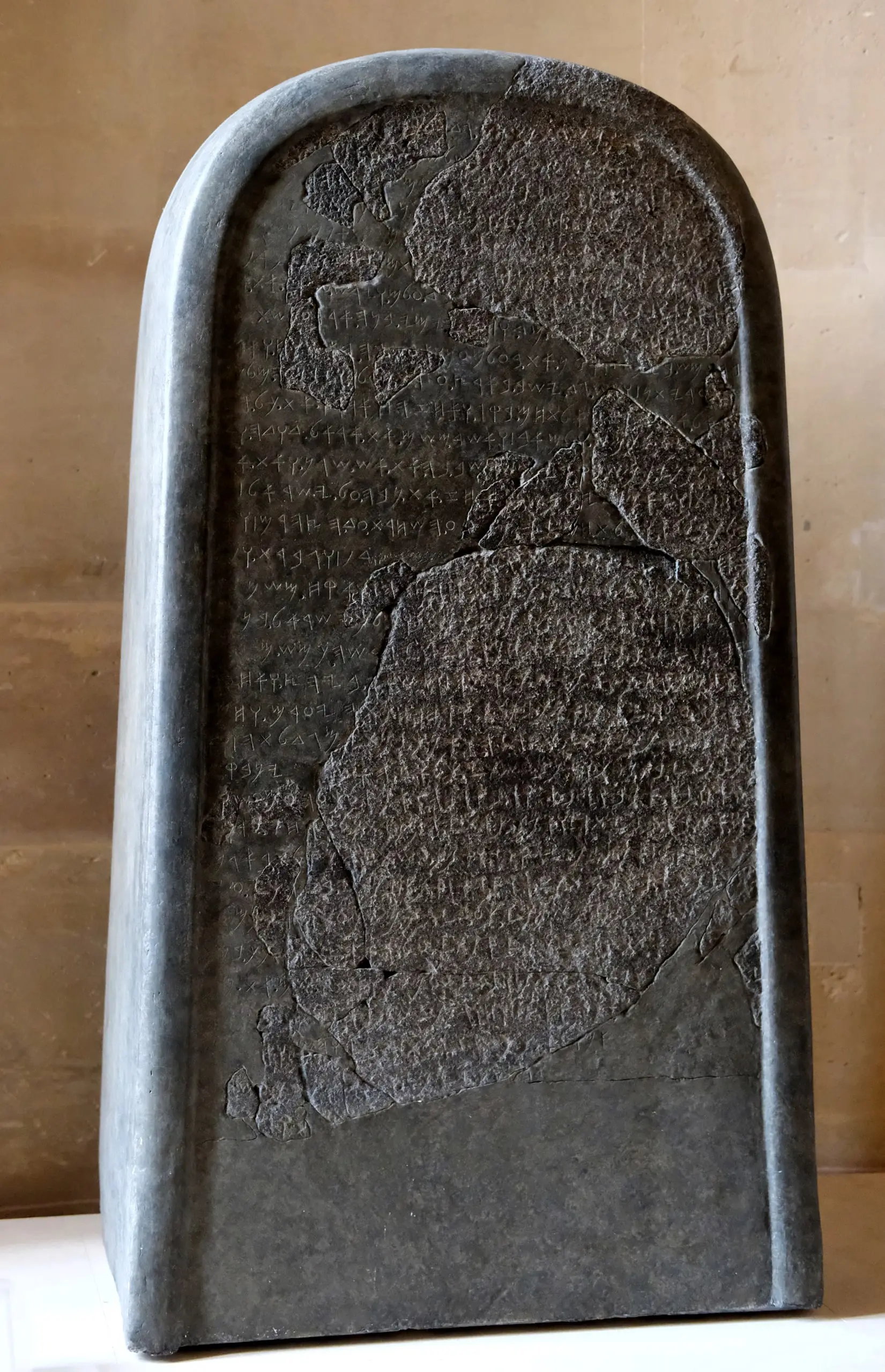
Three basalt fragments survive from a monumental inscription. The first was spotted on 21 July 1993 by the excavation’s surveyor, Gila Cook, reused as a building stone in a wall; the words are divided by dots. Two further fragments, found the following year, join it.
The stele belongs to the collection of the Israel Antiquities Authority and is on permanent display at the Israel Museum, which lent it to the Jewish Museum in New York in 2024–25.1,2,3
Why it matters
In the text an Aramaean king boasts of killing the king of Israel and a king of the “House of David”. Scholars generally attribute it to Hazael of Aram, although his name does not survive. The phrase is the earliest known reference to the royal House of David outside the Hebrew Bible — and the inscription’s account differs from 2 Kings 9, in which Jehu, not an Aramaean king, kills Jehoram and Ahaziah.1,2
“We have an inscription”
In 1993 Avraham Biran’s team was clearing the paved plaza outside the outer gate of Dan, at the foot of Mount Hermon beside one of the sources of the Jordan. On the east side of the plaza, below an eighth-century BC destruction level, the surveyor Gila Cook saw a basalt stone protruding from a wall, reused as building material. In the afternoon sun she thought she saw letters on it and called Biran over; bending down, he exclaimed, “Oh, my God, we have an inscription!” The wall had been destroyed by the Assyrian king Tiglath- pileser III in 733/732 BC, so the stele must have been set up — and broken — before then. Biran and the epigrapher Joseph Naveh published the fragment in the Israel Exploration Journal the same year.4
What survives of the text
Thirteen lines are preserved, none complete: the top and bottom of the stele are lost, as are the ends of all the lines. In Christopher Rollston’s translation, following Biran and Naveh’s arrangement of the fragments, the king recalls that his father “lay down and went to his fathers”, that the king of Israel had earlier invaded his father’s land, and that the god Hadad made him king and went before him. He claims to have killed seventy kings with thousands of chariots and horsemen, among them “[Jeho]ram son of [Ahab], king of Israel” and “[Ahaz]iahu son of [Jehoram], king of the house of David”. Rollston notes that the fragments do not join perfectly, but that enough survives to translate with confidence.5
One word for a dynasty
The words of the inscription are separated by dots, except in “House of David”: the letters bytdwd are written together, as if the dynastic name of Judah were a single word. Some scholars have proposed other readings, such as “house of the kettle” or “house of the uncle”, but the majority regard “House of David” as the only compelling translation. As Rollston stresses, the phrase refers to the Davidic dynasty rather than to David as a person. The first excavators’ report also pointed out that “king of Israel” here was then the oldest known mention of Israel in a Semitic script; the older Merneptah stele names Israel in hieroglyphs.4,5
Two claims to one killing
The king’s name is lost, but Rollston, like most scholars, attributes the stele to Hazael, who seized the throne of Damascus from Ben-Hadad. Drawing on the biblical account, he sees Hazael as allied with Jehu of Israel, another usurper. That, Rollston argues, explains why 2 Kings 9 credits Jehu with killing Jehoram of Israel and Ahaziah of Judah while the stele credits the Aramaean king: both men were working together, and both could claim the deed.5