The goddess stands half-draped, her himation slipping from her hips, her hair bound in a fillet and gathered in a chignon. The body was carved in two parts joined at the hips, the seam hidden in the drapery; a mortise shows that the left arm was made separately, and holes for a bronze diadem and bracelet show that she once wore metal jewellery. The left arm, most of the right arm and the left foot are lost.
Acquired almost immediately after its discovery by the Marquis de Rivière, then French ambassador, the statue was presented to Louis XVIII, who gave it to the Louvre in 1821. It stands almost alone in Room 345 of the Sully wing, the room where it was first displayed.1,2
Why it matters
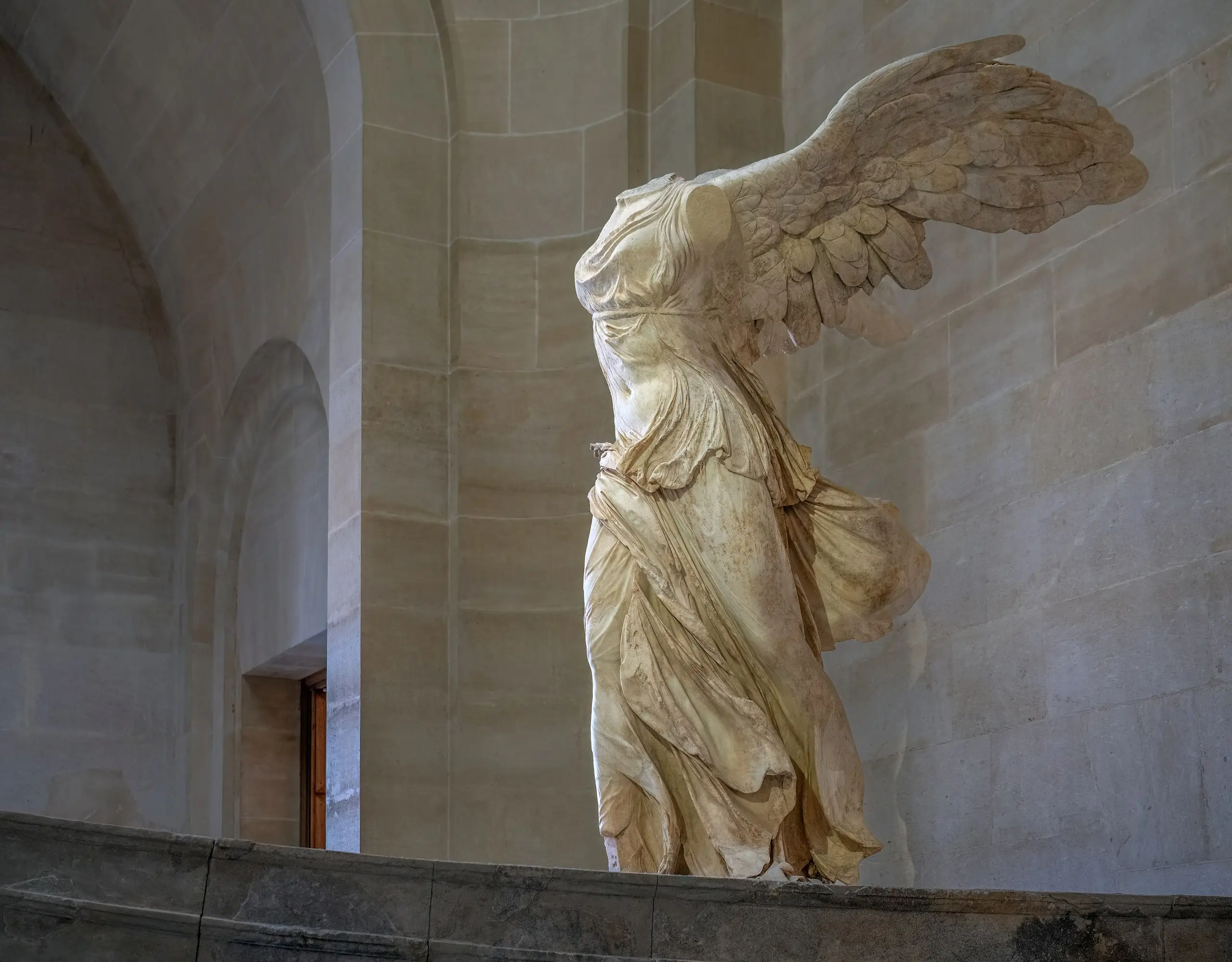
With the Mona Lisa and the Winged Victory, the Louvre counts her among the three most famous female figures in the museum. She is also a lesson in how attribution works without attributes: with the arms gone, the figure might be the sea goddess Amphitrite, worshipped on Melos, or Aphrodite. The sensual half-nude body, the lost jewellery and a marble hand holding an apple found nearby tipped the case toward Aphrodite — Venus to the Romans.2
How she was made
The statue is carved essentially from two blocks of Parian marble of the finest grade, known as lychnites. As was fairly common in the Greek world, and especially in the Cyclades where she was made, several parts — bust, legs, left arm and foot — were carved separately and fixed with vertical pegs. Only the holes remain of the metal jewellery she wore: a bracelet, earrings and a headband. The marble may once have been painted. The plinth was already recut in antiquity; in modern times the chignon was reattached and the tip of the nose made up in plaster.3,1
A goddess without attributes
Without arms or attributes, the figure has invited endless reconstructions. She has been imagined leaning on a pillar, resting her elbow on the shoulder of Ares, or holding a bow, which would make her Artemis, or a water jar, which would make her one of the Danaids. If she is Aphrodite, as her half-nudity and sensual curves suggest, she may have held an apple, recalling the Judgement of Paris, a crown, a mirror, or a shield in which she admired her reflection. Or she may be Amphitrite, the sea goddess venerated on Melos.3
Classical and Hellenistic
Because she resembles the Aphrodite of Capua in Naples, a Roman copy of a Greek original, the statue was once taken for a free replica of a work of the late fourth century BC. The Louvre now sees it as a classicising re- creation of the late second century BC. Her aloofness and the calm harmony of the face recall the art of the fifth century BC, and the hairstyle and soft modelling of the flesh the sculptor Praxiteles. But the spiral composition, the way the figure occupies three-dimensional space, and the long, small-breasted body belong to the Hellenistic period. She is caught holding her legs together as the drapery slides over her hips, the bare body set against the light and shade of the folds.3
In the Galerie des Antiques
The rooms where she stands replaced the royal apartments. After Napoleon I bought the collection of his brother-in-law Prince Camille Borghese in 1807, the architects Charles Percier and Pierre Fontaine enlarged the Galerie des Antiques, knocking through partition walls and adding grey and red marble to set off the white statues; the new rooms opened in 1811, ten years before the Venus arrived. She was moved several times — whether she should stand alone or among other works, and even whether she belonged among the paintings of the Grande Galerie, were long debated — before returning, after almost two centuries, to the room where she was first shown.2