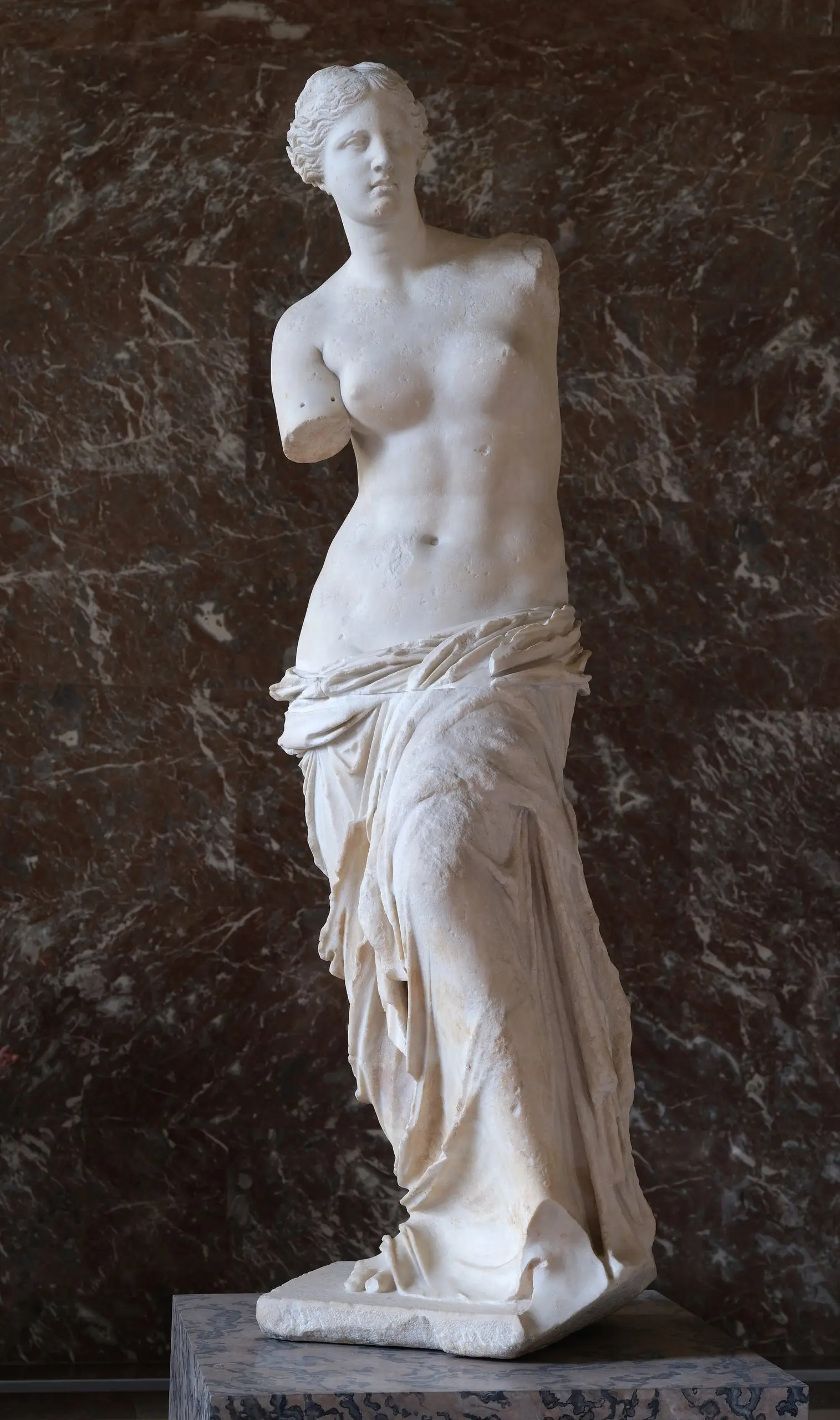
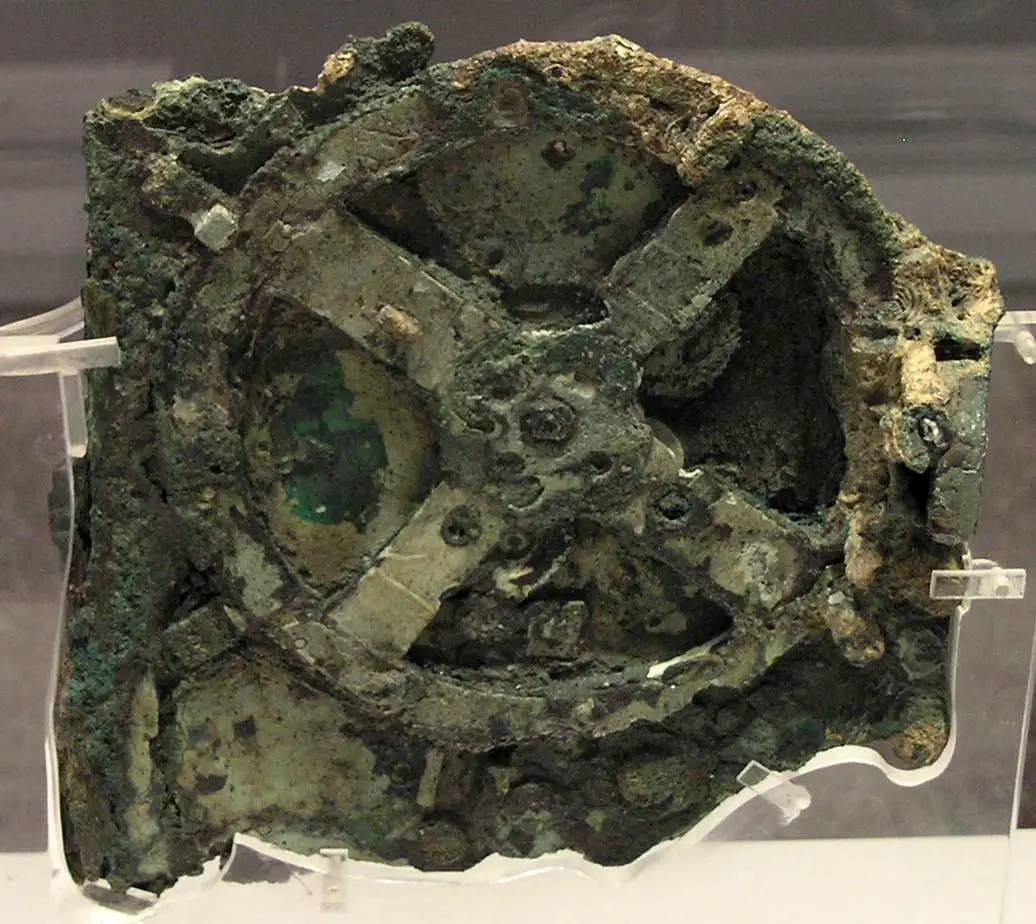
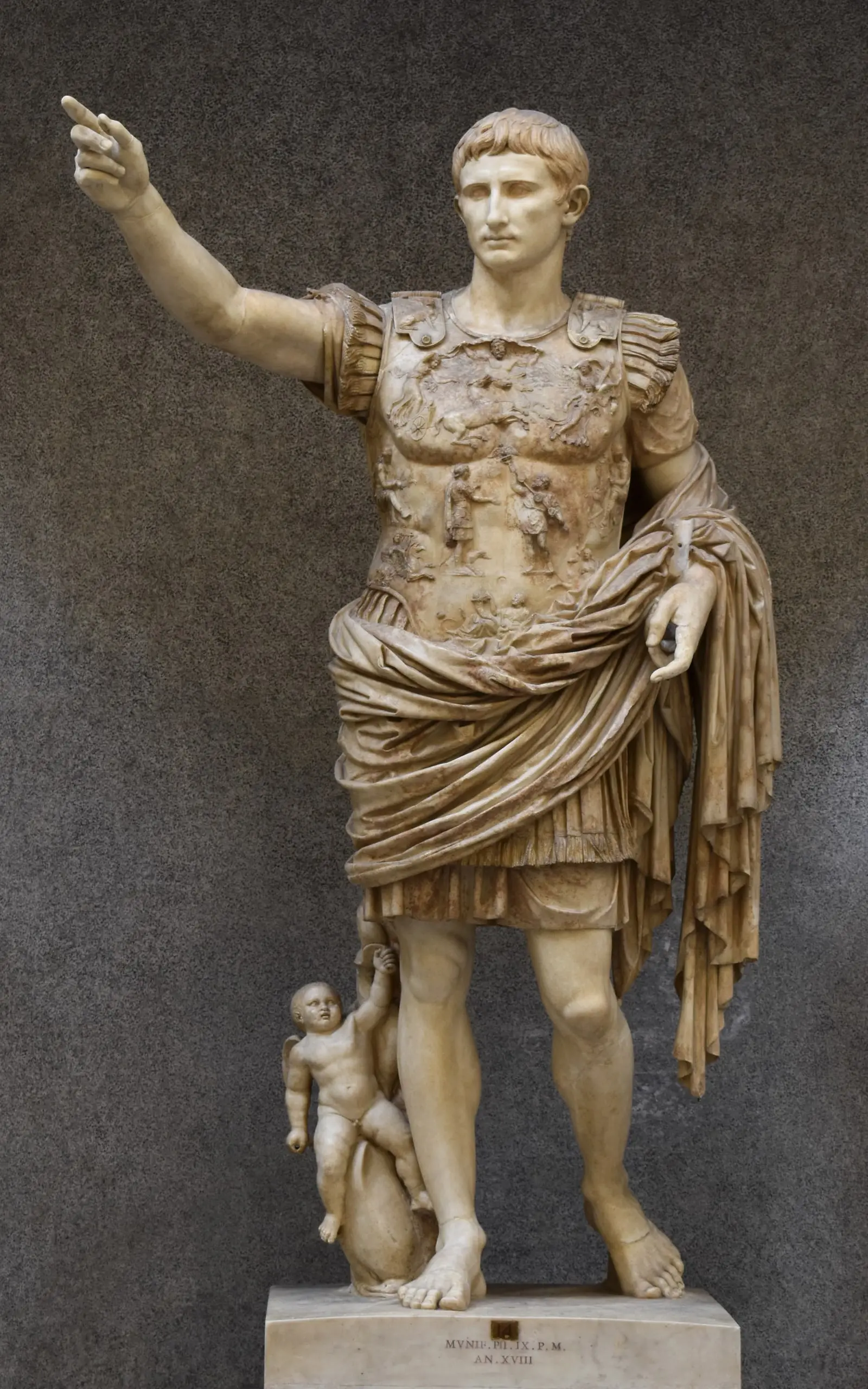
The goddess Nike, in a belted chiton and a himation blown against her body, alights on the prow of a ship. The torso and wings were carved separately and attached; the base is built of sixteen blocks in three courses. The head, neck, both arms and the right wing are lost — the right wing, the left breast and other areas are restored in plaster — and two feather fragments and nine pieces of the base were reintegrated in the last restoration, in 2014.
About 110 fragments were unearthed in 1863. Part of the right hand was found later: the thumb and part of a finger by an Austrian team in 1875, the palm by Jean Charbonneaux in 1950. It is shown on the landing of the Daru staircase.1,2
Why it matters
It is one of the rare Greek statues whose original setting is known: an offering to the Great Gods of Samothrace, placed high so it could be seen from afar. The Louvre suggests it celebrated a naval victory, perhaps won by the Rhodians, and its present position at the top of a monumental staircase was chosen to echo that lofty first home.2
Statue and ship
The monument stands 5.64 metres high in all. The goddess alone measures 3.28 metres and is estimated to weigh two tonnes; with the ship and plinth the whole weighs about 32 tonnes. She is carved from Parian marble, one of the finest marbles of Greece, while the ship’s prow, two metres high and more than four metres long, and the low plinth beneath it are of a different, grey stone that the Louvre identifies as Lartos marble. Parts of the drapery at the back and on the ground were carved separately and attached. Greek letters — alpha, beta, gamma, three deltas and epsilon — are cut into the six slabs of the plinth as marks for putting them together, and one block from the top course at the back of the ship is still kept in the museum on Samothrace.1
Three missions
Charles Champoiseau found the statue in 1863 in the Sanctuary of the Great Gods at Palaiopolis on Samothrace. Some 110 fragments came to light, but no head and no arms, and the first consignment reached the Louvre in 1864. Champoiseau returned in 1879 to search for the missing parts. He did not find them, but he did recover the plinth and the prow that had carried the statue, which arrived in Paris the same year; more pieces followed after a third mission in 1891. The wings, only partly preserved, were completed in plaster, and the statue has been restored several times since — the Louvre notes that it has kept changing shape ever since it was found.2,1
An offering to the Great Gods
The Louvre reads the statue as Victory alighting on a ship whose crew has just won a sea battle, commissioned to celebrate that victory. The winners, perhaps the people of Rhodes, set it up on Samothrace to thank the island’s Great Gods, the Cabeiri, who were worshipped throughout the Greek world. The right hand, found in pieces in 1875 and 1950, is 27 centimetres long and turns its palm upward in a gesture of victory; it is shown in a small case on the landing.2
On the Daru staircase
The Daru staircase is one of six grand staircases built for the Louvre by the architect Hector Lefuel under the Second Empire, when Napoleon III enlarged the palace. Victory was installed on its upper landing in 1883, some twenty years after her discovery. The domes above were then covered in heavily gilded mosaics, and some critics compared the goddess to a music-hall star; in 1934 the décor was hidden behind sober paper imitating cut stone.2